Here I describe our visit to Mauna Kea, the tallest peak in Hawaii.
Our original idea was to walk up the mountain - which several adventurist tourists do, but was replaced with a car trip, for two reasons - paucity of time and the severe weather conditions at the summit in the (February winter season. )
We incorporated the Mauna Kea visit, into our cross island ride on the Saddle Highway, that run from east side of the island to the west.
If you look closely in the map, you can see the the road we took - from Hilo, on the east, to the city of Kona on the west.
Mauna Kea can be seen marked in red, in the middle - a deviation of about 14 miles to the north, from the saddle road.
In Hawaiian language Mauna Kea means White Mountain, perhaps because of its winter ice cover.
The summit of Mauna Kea is 4,200 m [ 13,900 ft ] above sea level. It is very cold and windy at the top. The oxygen supply also begins to dwindle as you go up beyond 3000m.
Situated higher than the earth's tree line, not a blade of grass is seen at the top.
The air is so clean - so good that the best observatory in the world is set up here.
About 60 miles from Hilo, on the Saddle Highway, we take a right turn to Mauna Kea visitor center, to get information on high altitude and its effects.
One the good things about US Park Services is the quality of service they provide to visitors in helping them choose the best options within the time at their disposal.
The warnings posted at the Onizuka Visitor Center for International Astronomy,
at 9300 feet ( 3000 m. ) above sea level. There is a good video tour in the center hall, that gives the visitor an idea about the place.
A typical American Tourist Visitor Center will have Range Officer's desk, at most places a short free guided tours around the facility, restaurants, and without fail, the souvenir shops selling the monument's attractions like caps, picture cards and fridge magnets, printed mugs and other trivia.
Because of the extreme altitude of Mauna Kea, newly arriving astronomers and
engineers must acclimatize and live at an intermediate altitude for a while.
The Visitor Center also provides living facilities for them.
Just beyond the visitor center, the tarred road ends. Unpaved road takes you up the barren heights.
As you approach the earth's tree-line you can see the the last of the vegetation disappear behind you.
As we reach the summit and as we turn a curve, the huge telescopes come into view.
I am standing at 13,900 ft (4 km.) above sea level; for the first time in my life.
First time I experience earth's rarefied atmosphere. The shortage of oxygen is clearly discernible to my body.
This telescope facility is administered by University of Hawaii, with the support of several participating countries like UK, Japan, France and institutions like NASA. Being in the middle of the Pacific Ocean, isolated from dust and pollution, Mauna Kea is considered to be the best locations on earth for ground-based astronomy. More new satellites outside solar system has been discovered here, than any where else from ground based observatories.

The Volcano and its crater. Mauna Kea last erupted 4,600 years ago.
Here she is, - seen through the wind shield of our car. .
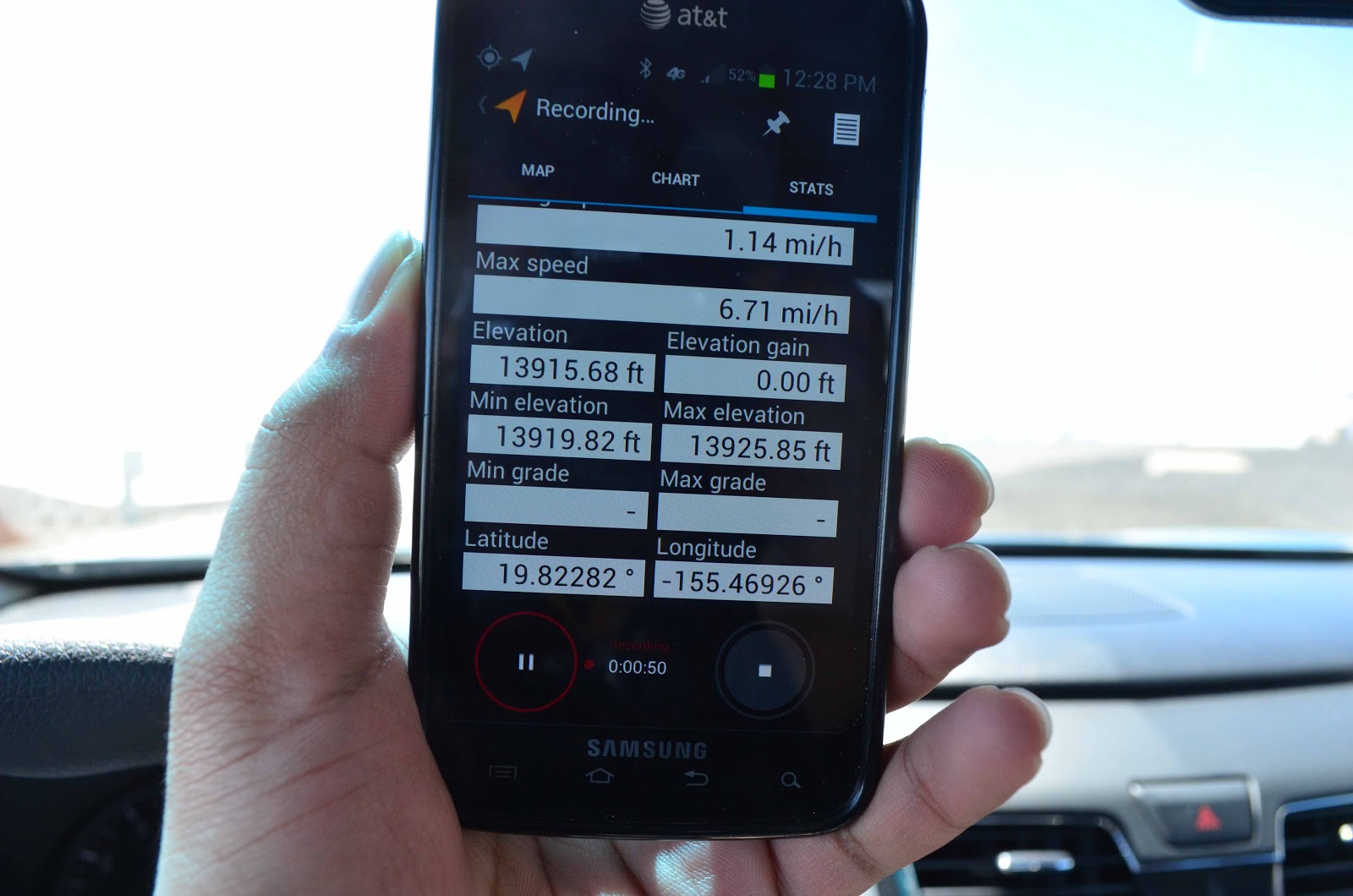
The speed and altitude being recorded by the GPS of my phone.
Smart phone has made redundant, my hand held Garmin GPS 60csx, bought for 299 dollars, only a couple of years ago.
And here is the our route tracked by the phone's Android App called "My Tracks".
Shortly, I intend to post a YouTube video in Malayalam, to demo, how this app works.
Mean while, Mathew's phone display the rate of ascend.
At this height you can clearly feel the effect of high altitude, of which we have only read about.
Irrespective of the huge investment and the wait period for scientists to use the research facility , this place allows visitors to take a free look through the telescope, Monday through Friday, during the day time.
I felt unlucky to have arrived on a Saturday and thereby missing the golden opportunity to look through one of the most powerful telescope on earth.
When I say it aloud, shivering in the bitter cold of the blasting wind, my companion disagrees.
"We are lucky to be here", is his short comment.
That is the truth.
The design of two telescopes displayed inside the closed facility.
I stay here a while before stepping into the merciless environment outside.
Mars like landscape, nothing green anywhere.
Mauna Kea is presently a dormant volcano, having last erupted about
4,500 years ago.
However, the scientists predicts that it is likely to erupt again.
On the way down, the grass reappear first then bush and then trees..
A peculiar flowering plant, at about 9000 feet, near the visitor center.
While they wave in the wind, it appears to be a thousand snakes collectively rearing their head up.
Later I find its name- Mullein.
Down hill, back on main road, we stop a while to look at the volcano from the bottom,
before we go on our way to Kailua Kona on the west coast.
Lonely highway called Saddle Road that connects Hilo & Kona.
Though, by US main-land standards, it is single lane and narrow -
the road is well built and properly maintained, making the ride fast and pleasurable.
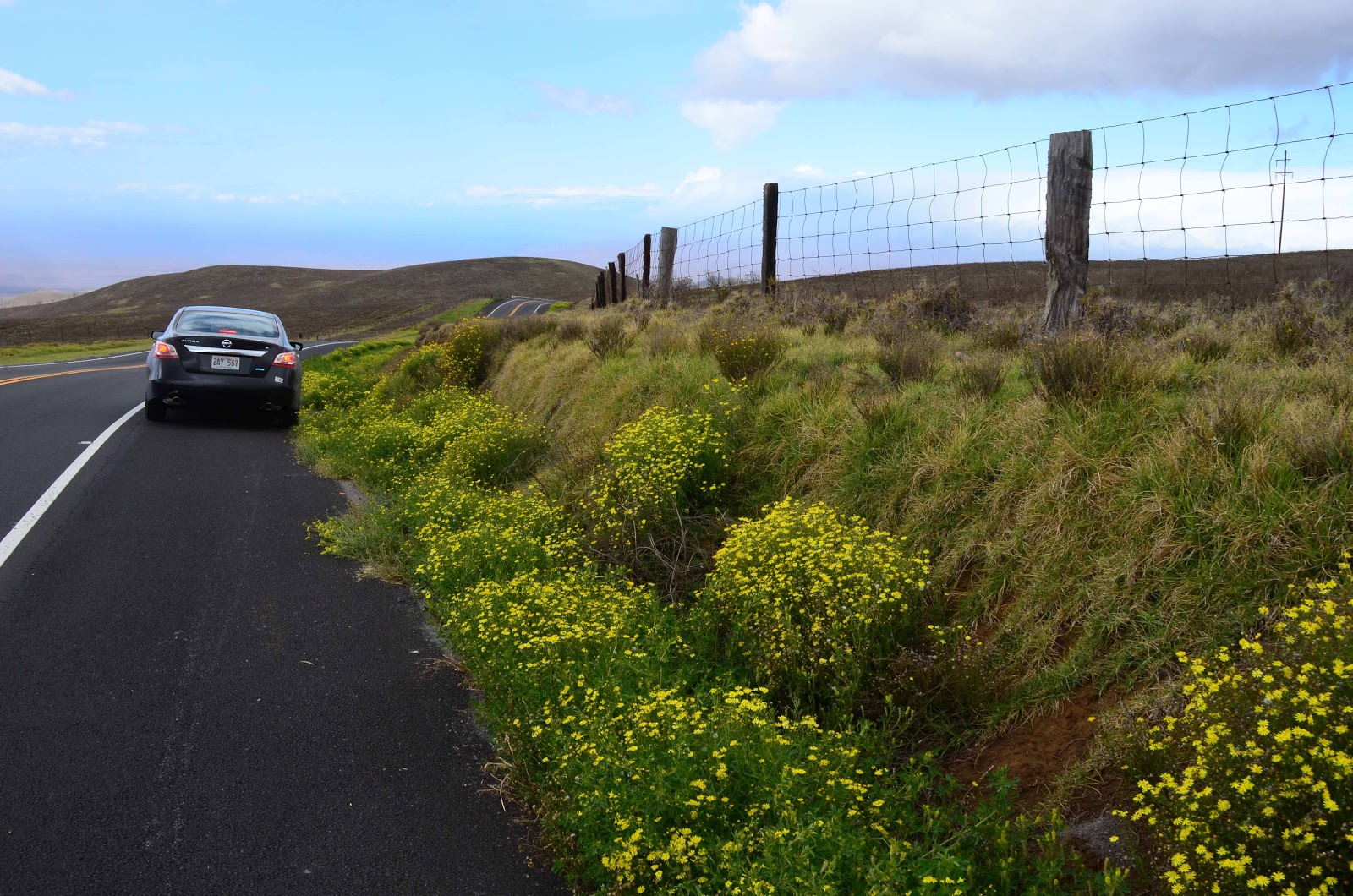
On the highway's edge a long line of plants called " Fire weed" that form a natural flower bed,
decorating the road like a wedding podium.
Close up of Fireweed.
Fireweed is particularly disliked by the farmers here as it contains a pyrrolizidine alkaloid which can cause liver damage in animals. There have been reports of cattle dying as a result of exposure to the plant. Something like the വിഷപ്പയര് in our rubber plantations.
Barren lands at the foot of Kea.
Beyond Kea's foot, on some part of the road travelers are not allowed to stop owing to
US military installations.

As one nears the west coast the landscape changes again.
t is always windy as the Pacific winds blows from the north, raking up huge waves.
So north coast of this island is a wind surfers paradise.
Finally we reach the west coast. The mighty Pacific greet us from the horizon.
A small town appears. The coast is tropical and windy.
The coconut tress are always flagging in the wind wildly.
From Kona we go to the north coast, famous for fabulous beaches, that gives Hawaii its fame.
The ferocious winds drive up the surf high over the surfers and surfers are
always around with their board.
The wind-surfing world completions are held here.
At Kona city as the day ends.
The old city airport abandoned for a new one outside the city is on the sea shore,
It is now a beach side park. A good place to view the Pacific sunset.
And also the time for us to go back to our hotel in Hilo. A long ride back all across the island.

Kona city by the night; view from the abandoned runway.
Coffee grown in the Kona region is very famous. Our hotel in Hilo, had provided Kona Beans coffee pouch for the room's electric coffee percolator.
I am a coffee-man and liked its aroma and strength.
It was already night as we began to drive all the way back. We have to cover 90 miles /(145 km.)
Soon heavy mist shrouded our car. We had not thought of this possibility. Visibility was merely 20 to 30 feet. Our car did not have fog lamps. As we got near to the foot of Mauna Kea, visbility dropped further.
I felt we had made a mistake to take the Saddle Road ( in the middle of the map) and should have taken the longer but safer sea side road to Hilo.
But the good pavement markings of the road helped us to navigate slowly across the foot of Mauna Kea, Fortunately soon the rain suddenly cleared the visibility for us.
Thankfully we drove to hotel, had a nice dinner and went to bed to catch the early morning flight to O'ahu.
But before that we have to return the rental car, to its station in front of the airport arrival. If we arrive before they open at 6 AM, all we have to do is to deposit the key into the drop box of the kiosk.
Hilo has a small airport, with old style looks.
Hilo airport arrival area.
This terminal building is mostly made with thick wooden tresses and planks
of the native trees, giving it an old world style.
The Hawaiian Airline's Boeing 717, that will take us back to O'ahu.
Not many have heard of Boeing 717, correct ? There is a story to it.
The aircraft was designed to be marketed by McDonnell Douglas as the MD-95. But before actual production, McDonnell Douglas and Boeing merged in 1997 and so the first planes entered service in 1999 as the Boeing 717.
It is the work horse of the local ' Hawaiian Airlines' , that cater to short distance hops between islands.
Next week :
The Volcanoes National Park of Hawai'i.
and later to end this series,
Pearl Harbour, Honolulu & Waikiki beach of O'ahu.